Copyright © 2026 by Coyote Steele LLC, All Rights Reserved by the Author. Permission to reprint without written permission of the author is prohibited.
Dispatch 3 (11/6/2026) — In which the Correspondent recalls an unexpected encounter with one of the greatest SF authors ever, rediscovers his classic work, and make a case for revisiting them as guideposts to one of the vital issues of our time.
It’s been said that you should never meet your heroes because you may come away disillusioned. There might be a certain amount of truth to that, but I’ve seldom had this epiphany myself. Perhaps it’s because I’ve always expected my heroes to be human beings, not idols, and so I’ve never put them on a pedestal where I couldn’t fail to notice their clay tootsies. Or maybe it’s simply because, when I’ve had unexpected encounters with people I admire, I’ve been fortunate to find that they’re the sort of folks I imagined they would be.
When I was 15 years old, I went to my first World Science Fiction Convention. This was in 1973 and the convention, which is held in a different city somewhere in the world every year, was in Toronto, making this the second time I’d visited Canada.[1] Because I travelled there with the Nashville Science Fiction Club, of which I was the only teenage member for a while[2], I was off the parental leash for a few days and able to do things I would’ve never been able to do otherwise… namely, go to parties and get drunk on Canadian beer (Molson’s Lager, much better than Schlitz, Miller’s, or Budweiser). But I was in the company of older people who loved science fiction as much as I did, and I had reasonably good manners, so as long as I didn’t set fire to anything they pretty much let me do whatever I wanted. A kid today probably couldn’t get away with half as much as I did back then, which is unfortunate; I think I grew up a bit more every time I went to an out-of-town SF convention because I had to learn to behave on adult terms.
Friday night around midnight, I found myself with a dozen other fans in the hotel mezzanine, standing in a circle singing filk songs[3]. We had copies of a mimeograph book of filk standards and decided to undertake the longest song in there: “Onward Sauron’s Soldiers,” an epic, tongue-in-cheek retelling of Tolkien’s Lord of the Rings sung to the tune of “Onward Christian Soldiers.” The lyrics are several pages long, and it usually takes an hour or more to get through the whole thing. When you’re three sheets in the wind, as most of us were, that’s a real challenge, but … well, it’s more fun than sleeping, right?
I think we’d been at it for about a half-hour or so, teetering on rubbery legs as we slurred our way through its dozens of stanzas and their refrain — “Onward Sauron’s soldiers/going as to war/with the ring of Mordor/going on before” — when a small group of people came strolling by. Older fans, well dressed, returning to the hotel after an evening on the town, had apparently decided to walk through the con to see what was going on. Seeing this cluster of filksters, one of them decided to come over and join the circle, and the person he picked to stand beside happened to be me. I didn’t really notice him on my left until he said quietly, “May I share your book with you?”
“Sure,” I said and passed the songbook over to him, not looking to see who was there. He took hold of the book’s left side as I held onto the right side and pointed out which stanza we were presently on. He joined right in and it was very much like if I was in church again, singing hymns on Sunday morning. My companion, a middle-aged man in his 50s, had a fine basso voice, and because my own singing voice is also deep we made for a good duet.
After a moment or so, though, I noticed out of the corner of my eye that everyone else was staring at us, some openly envious. That was when I turned my head and saw for the first time that my companion was none other than Isaac Asimov.
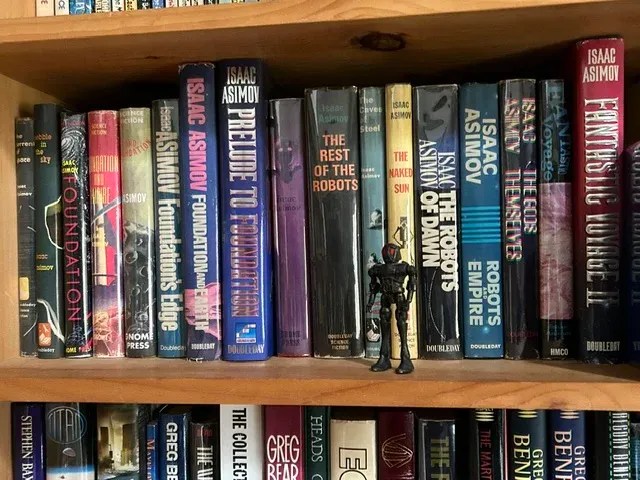
Lately I recalled that little episode as I began reading or re-reading some of the Good Doctor’s classic novels and stories. This happens if you’re a constant lifelong reader who always keeps the books he’s enjoyed while collecting others for later; every so often, you revisit an author whom you once enjoyed a lot, either revisiting books you read long ago or reading for the first time other books you’ve somehow overlooked even though you picked them up a while ago.
So, although I’ve read the Foundation Trilogy at least three times and frequently stumble upon an unread short story in an old SF magazine I recently added to my collection, there are some classic Asimov novels that I haven’t touched until just lately. The latter include his early novels The Stars, Like Dust and The Currents of Space, published in the early 50’s and belonging to the same future history that the Foundation novels belong to but occurring much earlier. Others I’ve had on my shelf for some time are The End of Eternity, which belongs to that same period, his later standalone novel Nemesis, published in 1998, and his next-to-last novel Prelude to Foundation. Also on tap is his final novel, Forward the Foundation, posthumously published in 1993 shortly after his death in 1992, and Fantastic Voyage II, his 1987 revision of his 1966 novelization of the movie Fantastic Voyage.
Some of these I’ve read all the way through, while others I started but didn’t finish. Truth to be told, although I admire Asimov’s work, nonetheless he’s not one of my very favorite authors. His later novels are more dialogue-driven than I like; Dr. Asimov himself once noted that over time he deliberately adopted a minimalistic style in order to get more books written, and I think this had the drawback of making some of his work rather dry. I know for a fact that he often wrote three or four books simultaneously, which was how he managed to publish 399 books in his lifetime, with several more completed but not published until after his death. Although I don’t think Asimov carelessly wrote anything, sometimes this kind of high-speed productivity can make even the best wrier produce dull prose … and I prefer slow-cooked meals to fast food.
During my current Asimov’s reading jag, I’ve found that the novels and stories that interest me the most are the ones about robots. Along with the Foundation novels, robots were a major theme of his SF career, representing some of his best work. I’ve just reread The Caves of Steel, the first of his three SF mystery novels featuring the detectives Lije Baley and R. Daneel Olivaw. I also have The Naked Sun on tap to re-read, and after that I intend to revisit The Robots of Dawn, a novel which I didn’t finish the first time around. Between these novels, I’ve been reading the linked stories in his collections I, Robot and The Rest of the Robots about U.S. Robots and robopsychologist Susan Calvin, one of the greatest characters of science fiction.
What’s fascinating about these particular novels and stories is that Asimov foresaw — and perhaps even influenced — the development of not only modern robotics but also artificial intelligence. Re-reading The Caves of Steel, serialized in Galaxy in 1953 and published in book form in 1954, I frequently came across descriptions of fictional robots that bore uncanny resemblance to recent videos of real-life humanoid robots. Likewise, some of Asimov’s short stories about rogue or runamok ‘bots prefigure real-life incidents of experimental or industrial robots having “hallucinations” or unprogrammed seizures.
Some of the issues Asimov raised in these works prefigure our current misgivings about AI, including how much control we still have over our creations when they start to teach themselves. The Three Laws of Robotics, which Asimov devised in conversation with his editor at Astounding Science Fiction, John W. Campbell Jr., have suddenly become pertinent. Whether they should be implemented in real-life robotics and the AIs that guide them is something that really needs to discussed at the highest levels as soon as possible, before it’s too late.
Isaac Asimov was one of the great visionaries of our time. But y’know what else? He was a fun guy to sing along with, too. — AMS
If you enjoy this column and want to support it and my writing in general, please make a donation, either one-time or by regular subscription, through my Patreon support site https://www.patreon.com/c/allensteele/shop or https://www.patreon.com/c/allensteele/membership. Your generosity is appreciated … thank you!
[1] I’ve been there many times since then and would even consider moving there if I could.
[2] In fact, I become known as its Juvenile Delinquent in Residence. The club is no more, but I still hold the title with pride.
[3] If you don’t know what this is, Google it. I won’t spend time explaining this particular fan tradition, but it was fun … or at least it was when I was a kid.
Comments are closed.