Copyright © 2026 by Coyote Steele LLC, All Rights Reserved by the Author
Dispatch 2 (10/23/2026) — In which the Correspondent observes the centennial of his favorite literary genre, wonders why no one else has noticed this, and shamefully confesses to forgetting his sisters’ birthdays while diligently remembering those of other women in his life.
Birthdays are an insidious thing. Everyone expects theirs to be celebrated, or at least remembered, but no one wants to be held accountable if they forget someone else’s. For instance, I have four older sisters, two of whom are still living, and I can never, ever remember their birthdays, even when I’ve taken pains to mark them on my calendar. This is embarrassing to admit, particularly since they’ve usually been good about remembering mine, but I’m absent-minded in that way.
On the other hand, a short time ago I stumbled upon an old wall calendar I kept from 1976 when I was a senior in high school and noticed that a particular day in April was marked “Caroline B’s birthday.” It took only a few seconds to remember what this was: a reminder to wish a certain classmate a happy birthday when I saw her at school that day, something I seldom if ever remembered to say to one of my own sisters. Caroline B — who wasn’t my girlfriend per se, but nonetheless a girl I liked a lot — has long since disappeared from my life, yet but my sisters Lilli and Damaris are still around (although my other sisters Genevieve and Rachel are not). This shows where my priorities lay back then … and probably now, too, because I never fail to remember my wife’s birthday.[1]
2026 is the 250th birthday of American independence (though it could be argued that the United States of America didn’t actually come into existence until March 1, 1781, when the Articles of Confederation were finally ratified by the thirteen original colonies, thereby transforming them into states of a larger union). It’s been observed, to one extent or another, that although this year’s Fourth of July celebrations were somewhat low-key in comparison those of the 1976 Bicentennial, a couple of months after my pal Caroline received birthday felicitations from me. Yet even this muted “so what, big deal” reaction is a glorious fireworks display in comparison to public recognition of an important 100th birthday which also happened this year, but has come and gone with barely a shrug.
And it is this: 2026 marks the one hundredth anniversary of science fiction as a distinct literary genre.
Science fiction has been a form of imaginative literature since at least 1818, when Mary Shelley’s Frankenstein was published. Although I belong to the camp that considers Jules Verne’s From Earth to the Moon, published in 1865, to be the actual first SF novel, most genre historians, myself included, concur that it wasn’t until April 1926 that’ science fiction became a separate and definable genre.
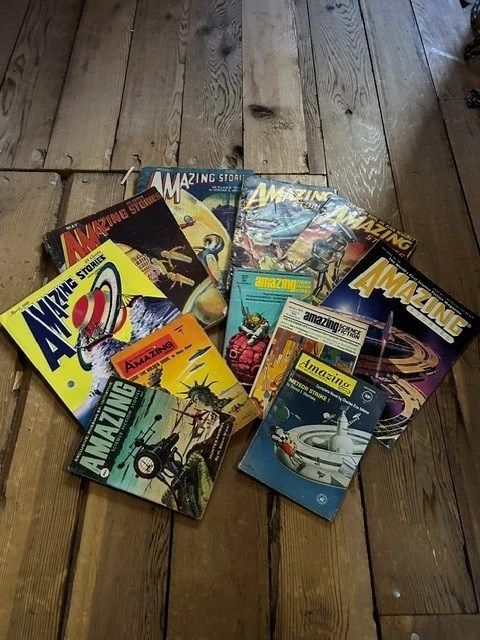
That was when the first issue of Amazing Stories was published. The issue was kicked off by an editorial, “A New Sort of Magazine,” written by Hugo Gernsbeck, the magazine’s publisher and first editor, and it’s hard to imagine a more sublime inauguration. Amazing really was a new sort of magazine; Gernsbeck even coined a new word for its contents, “scientifiction.”[2] Fortunately, that tongue-twister didn’t stick; it was eventually replaced circa 1930 by the more pronouncable “science-fiction” and later “science fiction” once the inconvenient and unnecessary hyphen was lost.
Whatever it’s called, though, the genre would grow through the century to come, surviving economic depressions and wars and political shifts to both the right and the left, evolving alongside social and cultural changes, and finally achieving both artistic respect and global popularity. In 2026, science fiction is no longer kid stuff or junk that interests only geeks. It has become a major influence on modern culture and a mover and shaper of high technology.[3]
Several classic SF novels are now required reading in school (Ray Bradbury’s Fahrenheit 451, for example; ironically, the same book is also one of the most frequently banned). The biggest movie blockbusters every year are usually science fiction or at least SF-related. As I write, theaters are already selling advance tickets for Dune: Part Three. And don’t dare visit downtown Atlanta around Labor Day if you detest SF, fantasy, or comics; DragonCon completely takes over the city center that weekend, and you better either love this stuff or stay home and watch football.
Despite all that, science fiction’s 100th birthday has been largely forgotten. So far as I’ve noticed, but none of the major SF websites or blogs have commented about this anniversary. None of the magazines except Amazing Stories itself[4] have mentioned this in their editorials or columns. I have attended just one SF convention this year, Boskone in Boston, but it wasn’t talked about there, and when I skimmed the program schedules of others I didn’t see any panels or events on this subject at them either. No documentary films on Netflix or Prime. Hell, even Bill Maurer forgot, though he says he smokes a lot of pot so I guess that explains things.
It’s as if everyone forgot to mark on their calendars the birthday of their favorite girl or boy. And I have no explanation for this except that the genre may have become a victim of its success. Sometimes, when something is so successful that it becomes institutionalized, its existence is taken for granted … and that’s the first step toward extinction.
I wish I had Caroline’s phone number or even know where she lives now. I would’ve called last April to wish her a happy 68th birthday (she was my age). But we know where science fiction is now. Is it too much to ask for someone besides me to remember its birthday?
— Allen
If you enjoy this column and want to support it and my writing in general, please make a donation, either one-time or by regular subscription, through my Patreon support site https://www.patreon.com/c/allensteele/shop or https://www.patreon.com/c/allensteele/membership. Your generosity is appreciated … thank you!
[1] We’ve been married 39 years. I wouldn’t dare.
[2] It’s actually easy to pronounce: “sci-ant-tea-fiction.”
[3] That’s a subject I might write about another time in this column if I think to do it later.
[4] Where, if I may modestly add, I have a short story in the centennial issue.